Realize that everything connects to everything else.
― Leonardo da Vinci
As is usually the case with NYT articles, the one titled “The Insect Apocalypse Is Here – What does it mean for the rest of life on Earth” is too long. Yet, I still found it to be one of the most holistic articles on the topic of insect mass-die-off I have read thus far. For those pressed for time, I have shortened the article – hopefully without it losing depth – below.

Because insects are legion, inconspicuous and hard to meaningfully track, the fear that there might be far fewer than before was more felt than documented. People noticed it by canals or in backyards or under streetlights at night — familiar places that had become unfamiliarly empty. The feeling was so common that entomologists developed a shorthand for it, named for the way many people first began to notice that they weren’t seeing as many bugs. They called it the windshield phenomenon.
Insects are the vital pollinators and recyclers of ecosystems and the base of food webs everywhere. In the United States, scientists recently found the population of monarch butterflies fell by 90 percent in the last 20 years, a loss of 900 million individuals; the rusty-patched bumblebee, which once lived in 28 states, dropped by 87 percent over the same period. With other, less-studied insect species, one butterfly researcher told me, “all we can do is wave our arms and say, ‘It’s not here anymore!’ ” Still, the most disquieting thing wasn’t the disappearance of certain species of insects; it was the deeper worry, that a whole insect world might be quietly going missing, a loss of abundance that could alter the planet in unknowable ways. “We notice the losses,” says David Wagner, an entomologist at the University of Connecticut. “It’s the diminishment that we don’t see.”
A paper by an obscure German entomological society had brought the problem of insect decline into sharp focus. The German study found that, measured simply by weight, the overall abundance of flying insects in German nature reserves had decreased by 75 percent over just 27 years. If you looked at midsummer population peaks, the drop was 82 percent.
The study would quickly become, according to the website Altmetric, the sixth-most-discussed scientific paper of 2017. Headlines around the world warned of an “insect Armageddon.”
We’ve named and described a million species of insects, a stupefying array of thrips and firebrats and antlions and caddis flies and froghoppers and other enormous families of bugs that most of us can’t even name. The ones we think we do know well, we don’t: There are 12,000 types of ants, nearly 20,000 varieties of bees, almost 400,000 species of beetles, so many that the geneticist J.B.S. Haldane reportedly quipped that God must have an inordinate fondness for them. A bit of healthy soil a foot square and two inches deep might easily be home to 200 unique species of mites, each, presumably, with a subtly different job to do. And yet entomologists estimate that all this amazing, absurd and understudied variety represents perhaps only 20 percent of the actual diversity of insects on our planet — that there are millions and millions of species that are entirely unknown to science.
With so much abundance, it very likely never occurred to most entomologists of the past that their multitudinous subjects might dwindle away. As they poured themselves into studies of the life cycles and taxonomies of the species that fascinated them, few thought to measure or record something as boring as their number. Besides, tracking quantity is slow, tedious and unglamorous work: setting and checking traps, waiting years or decades for your data to be meaningful, grappling with blunt baseline questions instead of more sophisticated ones. And who would pay for it? Most academic funding is short-term, but when what you’re interested in is invisible, generational change, says Dave Goulson, an entomologist at the University of Sussex, “a three-year monitoring program is no good to anybody.” This is especially true of insect populations, which are naturally variable, with wide, trend-obscuring fluctuations from one year to the next.
When entomologists began noticing and investigating insect declines, they lamented the absence of solid information from the past in which to ground their experiences of the present. “We see a hundred of something, and we think we’re fine,” Wagner says, “but what if there were 100,000 two generations ago?” Rob Dunn, an ecologist at North Carolina State University, recently searched for studies showing the effect of pesticide spraying on the quantity of insects living in nearby forests. He was surprised to find that no such studies existed. “We ignored really basic questions,” he said. “It feels like we’ve dropped the ball in some giant collective way.”
Entomologists also knew that climate change and the overall degradation of global habitat are bad news for biodiversity in general, and that insects are dealing with the particular challenges posed by herbicides and pesticides, along with the effects of losing meadows, forests and even weedy patches to the relentless expansion of human spaces. There were studies of other, better-understood species that suggested that the insects associated with them might be declining, too. People who studied fish found that the fish had fewer mayflies to eat. Ornithologists kept finding that birds that rely on insects for food were in trouble: eight in 10 partridges gone from French farmlands; 50 and 80 percent drops, respectively, for nightingales and turtledoves. Half of all farmland birds in Europe disappeared in just three decades. At first, many scientists assumed the familiar culprit of habitat destruction was at work, but then they began to wonder if the birds might simply be starving.
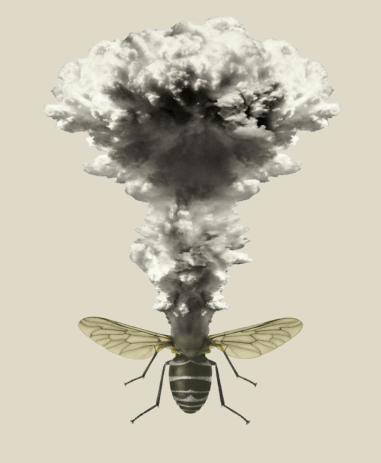
Then came the German study. Scientists are still cautious about what the findings might imply about other regions of the world. But the study brought forth exactly the kind of longitudinal data they had been seeking, and it wasn’t specific to just one type of insect. The numbers were stark, indicating a vast impoverishment of an entire insect universe, even in protected areas where insects ought to be under less stress. The speed and scale of the drop were shocking even to entomologists who were already anxious about bees or fireflies or the cleanliness of car windshields.
The results were surprising in another way too. The long-term details about insect abundance, the kind that no one really thought existed, hadn’t appeared in a particularly prestigious journal and didn’t come from university-affiliated scientists, but from a small society of insect enthusiasts based in the modest German city Krefeld.
In 2013, Krefeld entomologists confirmed that the total number of insects caught in one nature reserve was nearly 80 percent lower than the same spot in 1989. They had sampled other sites, analyzed old data sets and found similar declines: Where 30 years earlier, they often needed a liter bottle for a week of trapping, now a half-liter bottle usually sufficed. But it would have taken even highly trained entomologists years of painstaking work to identify all the insects in the bottles. So the society used a standardized method for weighing insects in alcohol, which told a powerful story simply by showing how much the overall mass of insects dropped over time. “A decline of this mixture,” Sorg said, “is a very different thing than the decline of only a few species.”
The society collaborated with de Kroon and other scientists at Radboud University in the Netherlands, who did a trend analysis of the data that Krefeld provided, controlling for things like the effects of nearby plants, weather and forest cover on fluctuations in insect populations. The final study looked at 63 nature preserves, representing almost 17,000 sampling days, and found consistent declines in every kind of habitat they sampled. This suggested, the authors wrote, “that it is not only the vulnerable species but the flying-insect community as a whole that has been decimated over the last few decades.”
The current worldwide loss of biodiversity is popularly known as the sixth extinction: the sixth time in world history that a large number of species have disappeared in unusually rapid succession, caused this time not by asteroids or ice ages but by humans. When we think about losing biodiversity, we tend to think of the last northern white rhinos protected by armed guards, of polar bears on dwindling ice floes. Extinction is a visceral tragedy, universally understood: There is no coming back from it. The guilt of letting a unique species vanish is eternal.
But extinction is not the only tragedy through which we’re living. What about the species that still exist, but as a shadow of what they once were? In “The Once and Future World,” the journalist J.B. MacKinnon cites records from recent centuries that hint at what has only just been lost: “In the North Atlantic, a school of cod stalls a tall ship in midocean; off Sydney, Australia, a ship’s captain sails from noon until sunset through pods of sperm whales as far as the eye can see. … Pacific pioneers complain to the authorities that splashing salmon threaten to swamp their canoes.” There were reports of lions in the south of France, walruses at the mouth of the Thames, flocks of birds that took three days to fly overhead, as many as 100 blue whales in the Southern Ocean for every one that’s there now. “These are not sights from some ancient age of fire and ice,” MacKinnon writes. “We are talking about things seen by human eyes, recalled in human memory.”
What we’re losing is not just the diversity part of biodiversity, but the bio part: life in sheer quantity. While I was writing this article, scientists learned that the world’s largest king penguin colony shrank by 88 percent in 35 years, that more than 97 percent of the bluefin tuna that once lived in the ocean are gone. The number of Sophie the Giraffe toys sold in France in a single year is nine times the number of all the giraffes that still live in Africa.
Finding reassurance in the survival of a few symbolic standard-bearers ignores the value of abundance, of a natural world that thrives on richness and complexity and interaction. Tigers still exist, for example, but that doesn’t change the fact that 93 percent of the land where they used to live is now tigerless. This matters for more than romantic reasons: Large animals, especially top predators like tigers, connect ecosystems to one another and move energy and resources among them simply by walking and eating and defecating and dying. (In the deep ocean, sunken whale carcasses form the basis of entire ecosystems in nutrient-poor places.) One result of their loss is what’s known as trophic cascade, the unraveling of an ecosystem’s fabric as prey populations boom and crash and the various levels of the food web no longer keep each other in check. These places are emptier, impoverished in a thousand subtle ways.
Scientists have begun to speak of functional extinction (as opposed to the more familiar kind, numerical extinction). Functionally extinct animals and plants are still present but no longer prevalent enough to affect how an ecosystem works. Some phrase this as the extinction not of a species but of all its former interactions with its environment — an extinction of seed dispersal and predation and pollination and all the other ecological functions an animal once had, which can be devastating even if some individuals still persist. The more interactions are lost, the more disordered the ecosystem becomes. A 2013 paper in Nature, which modeled both natural and computer-generated food webs, suggested that a loss of even 30 percent of a species’ abundance can be so destabilizing that other species start going fully, numerically extinct — in fact, 80 percent of the time it was a secondarily affected creature that was the first to disappear. A famous real-world example of this type of cascade concerns sea otters. When they were nearly wiped out in the northern Pacific, their prey, sea urchins, ballooned in number and decimated kelp forests, turning a rich environment into a barren one and also possibly contributing to numerical extinctions, notably of the Steller’s sea cow.
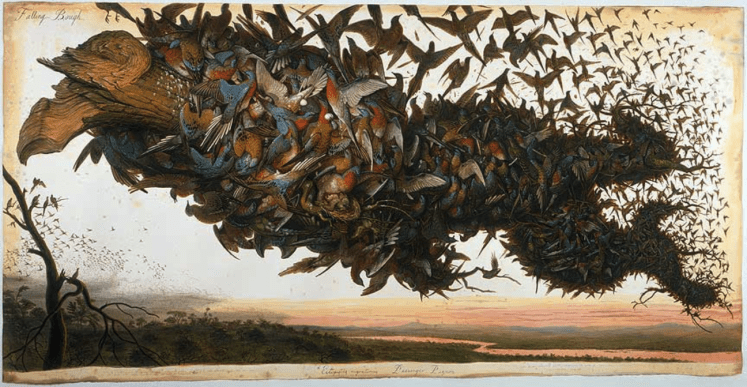
Conservationists tend to focus on rare and endangered species, but it is common ones, because of their abundance, that power the living systems of our planet. Most species are not common, but within many animal groups most individuals — some 80 percent of them — belong to common species. Like the slow approach of twilight, their declines can be hard to see. White-rumped vultures were nearly gone from India before there was widespread awareness of their disappearance. Describing this phenomenon in the journal BioScience, Kevin Gaston, a professor of biodiversity and conservation at the University of Exeter, wrote: “Humans seem innately better able to detect the complete loss of an environmental feature than its progressive change.”
In addition to extinction (the complete loss of a species) and extirpation (a localized extinction), scientists now speak of defaunation: the loss of individuals, the loss of abundance, the loss of a place’s absolute animalness. In a 2014 article in Science, researchers argued that the word should become as familiar, and influential, as the concept of deforestation. In 2017 another paper reported that major population and range losses extended even to species considered to be at low risk for extinction. They predicted “negative cascading consequences on ecosystem functioning and services vital to sustaining civilization” and the authors offered another term for the widespread loss of the world’s wild fauna: “biological annihilation.”
A study published this year in the Proceedings of the National Academy of Sciences found that if you look at the world’s mammals by weight, 96 percent of that biomass is humans and livestock; just 4 percent is wild animals.
Bugs are vital to the decomposition that keeps nutrients cycling, soil healthy, plants growing and ecosystems running. This role is mostly invisible, until suddenly it’s not. After introducing cattle to Australia at the turn of the 19th century, settlers soon found themselves overwhelmed by the problem of their feces: For some reason, cow pies there were taking months or even years to decompose. Cows refused to eat near the stink, requiring more and more land for grazing, and so many flies bred in the piles that the country became famous for the funny hats that stockmen wore to keep them at bay. It wasn’t until 1951 that a visiting entomologist realized what was wrong: The local insects, evolved to eat the more fibrous waste of marsupials, couldn’t handle cow excrement. For the next 25 years, the importation, quarantine and release of dozens of species of dung beetles became a national priority. And that was just one unfilled niche. Only about 2 percent of invertebrate species have been studied enough for us to estimate whether they are in danger of extinction, never mind what dangers that extinction might pose.
When asked to imagine what would happen if insects were to disappear completely, scientists find words like chaos, collapse, Armageddon. Wagner, the University of Connecticut entomologist, describes a flowerless world with silent forests, a world of dung and old leaves and rotting carcasses accumulating in cities and roadsides, a world of “collapse or decay and erosion and loss that would spread through ecosystems” — spiraling from predators to plants. E.O. Wilson has written of an insect-free world, a place where most plants and land animals become extinct; where fungi explodes, for a while, thriving on death and rot; and where “the human species survives, able to fall back on wind-pollinated grains and marine fishing” despite mass starvation and resource wars. “Clinging to survival in a devastated world, and trapped in an ecological dark age,” he adds, “the survivors would offer prayers for the return of weeds and bugs.”
The insects in the forest that Lister studied haven’t been contending with pesticides or habitat loss, the two problems to which the Krefeld paper pointed. Instead, Lister chalks up their decline to climate change, which has already increased temperatures in Luquillo by two degrees Celsius since Lister first sampled there. Previous research suggested that tropical bugs will be unusually sensitive to temperature changes; in November, scientists who subjected laboratory beetles to a heat wave reported that the increased temperatures made them significantly less fertile. Other scientists wonder if it might be climate-induced drought or possibly invasive rats or simply “death by a thousand cuts” — a confluence of many kinds of changes to the places where insects once thrived.
The diversity of insects means that some will manage to make do in new environments, some will thrive (abundance cuts both ways: agricultural monocultures, places where only one kind of plant grows, allow some pests to reach population levels they would never achieve in nature) and some, searching for food and shelter in a world nothing like the one they were meant for, will fail. While we need much more data to better understand the reasons or mechanisms behind the ups and downs, Thomas says, “the average across all species is still a decline.”
Thomas believes that this naturalist tradition is also why Europe is acting much faster than other places — for example, the United States — to address the decline of insects: Interest leads to tracking, which leads to awareness, which leads to concern, which leads to action. Since the Krefeld data emerged, there have been hearings about protecting insect biodiversity in the German Bundestag and the European Parliament. European Union member states voted to extend a ban on neonicotinoid pesticides and have begun to put money toward further studies of how abundance is changing, what is causing those changes and what can be done.
Stemming insect declines will require much more than this, however. The European Union already had some measures in place to help pollinators — including more strictly regulating pesticides than the United States does and paying farmers to create insect habitats by leaving fields fallow and allowing for wild edges alongside cultivation — but insect populations dropped anyway. New reports call for national governments to collaborate; for more creative approaches such as integrating insect habitats into the design of roads, power lines, railroads and other infrastructure; and, as always, for more studies. The necessary changes, like the causes, may be profound. “It’s just another indication that we’re destroying the life-support system of the planet,” Lister says of the Puerto Rico study. “Nature’s resilient, but we’re pushing her to such extremes that eventually it will cause a collapse of the system.”
Scientists hope that insects will have a chance to embody that resilience. While tigers tend to give birth to three or four cubs at a time, a ghost moth in Australia was once recorded laying 29,100 eggs, and she still had 15,000 in her ovaries. The fecund abundance that is insects’ singular trait should enable them to recover, but only if they are given the space and the opportunity to do so.
“It’s a debate we need to have urgently,” Goulson says. “If we lose insects, life on earth will. …”

 Gordon Schücker