Those who are crazy enough to think they can change the world usually do.
— Steve Jobs
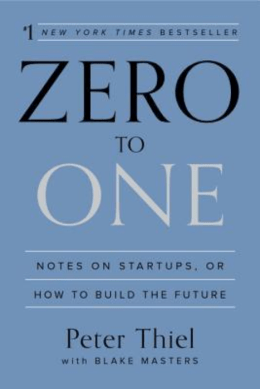
One of my favorite Tim Ferriss Podcasts is this one with Derek Sivers: On Developing Confidence, Finding Happiness, and Saying “No” to Millions [Transcript here]. Long story short, Derik Sivers publishes the notes of the many books he has read, enabling one to extract their essence without having to read through hundreds of pages. While I love reading and would highly recommend Peter Thiel’s whole book – it belongs to my top 10, there is a high chance you will never read it. But to still get 60% of its value, you may read the following notes. Most of them have been copy-pasted from Derek’s book notes with some personal complements and my highlighting.
***
Every moment in business happens only once. The next Bill Gates will not build an operating system. The next Larry Page or Sergey Brin won’t make a search engine. And the next Mark Zuckerberg won’t create a social network.
We are going to need miracles. We call these miracles technology.
It allows us to do more with less, find value in unexpected places.
The future will be a time when the world looks different from today.
Most people think the future of the world will be defined by globalization, but the truth is that technology matters more.
A startup is the largest group of people you can convince of a plan to build a different future. A new company’s most important strength is new thinking.
What a startup has to do: question received ideas and rethink business from scratch.
Four big lessons from the dot-com crash that still guide business thinking today:
- Make incremental advances
- Stay lean and flexible
- Improve on the competition
- Focus on product, not sales
Yet the opposite principles are probably more correct:
- It is better to risk boldness than triviality.
- A bad plan is better than no plan.
- Competitive markets destroy profits.
- Sales matters just as much as product.
How much of what you know about business is shaped by mistaken reactions to past mistakes?
What valuable company is nobody building?
Creating value is not enough – you also need to capture some of the value you create.
By “monopoly,” we mean the kind of company that’s so good at what it does that no other firm can offer a close substitute. Google is a good example. 95% of Google’s revenue comes from search advertising.
Framing itself as just another tech company allows Google to escape all sorts of unwanted attention.
Entrepreneurs understate the scale of competition, but that is the biggest mistake a startup can make. The fatal temptation is to describe your market extremely narrowly so that you dominate it by definition.
When you hear that most new restaurants fail within one or two years, your instinct will be to come up with a story about how yours is different. You’ll spend time trying to convince people that you are exceptional instead of seriously considering whether that’s true.
In business, money is either an important thing or it is everything. Monopolists can afford to think about things other than making money; non-monopolists can’t.
Only monopoly profits allow a business to transcend the daily brute struggle for survival.
All happy companies earn a monopoly by solving a unique problem. All failed companies are the same: they failed to escape competition.
Monopoly is the condition of every successful business.
Competition means no profits for anybody, no meaningful differentiation, and a struggle for survival.
The more we compete, the less we gain.
The hazards of imitative competition may partially explain why individuals with an Asperger’s-like social ineptitude seem to be at an advantage in Silicon Valley today. If you’re less sensitive to social cues, you’re less likely to do the same things as everyone else around you.
Proprietary technology is the most substantive advantage a company can have.
Proprietary technology must be at least 10 times better than its closest substitute in some important dimension to lead to a real monopolistic advantage. Anything less than an order of magnitude better will probably be perceived as a marginal improvement and will be hard to sell,
The clearest way to make a 10x improvement is to invent something completely new. If you build something valuable where there was nothing before, the increase in value is theoretically infinite.
Successful network businesses rarely get started by MBA types: the initial markets are so small that they often don’t even appear to be business opportunities at all.
Every startup should start with a very small market. Reach a few thousand people who really needed your product.
The perfect target market for a startup is a small group of particular people concentrated together and served by few or no competitors.
It’s always a red flag when entrepreneurs talk about getting 1% of a $100 billion market.
Don’t disrupt: avoid competition.
First mover advantage? It’s much better to be the last mover. Make the last great development in a specific market and enjoy years of monopoly profits.
Study the endgame before everything else.
Whether success comes from luck or skill: Is there a way to settle this debate objectively? Unfortunately not, because statistics doesn’t work when the sample size is one.
However, the phenomenon of serial entrepreneurship would seem to call into question our tendency to explain success as the product of chance. Hundreds of people have started multiple multimillion-dollar businesses.
If you believe your life is mainly a matter of chance, why read this book? Learning about startups is worthless if you’re just reading stories about people who won the lottery.
You can expect the future to take a definite form or you can treat it as hazily uncertain. If you treat the future as something definite, it makes sense to understand it in advance and to work to shape it. But if you expect an indefinite future ruled by randomness, you’ll give up on trying to master it.
You can also expect the future to be either better or worse than the present. Optimists welcome the future; pessimists fear it. Combining these possibilities yields four views:

INDEFINITE PESSIMISM
This describes Europe. An indefinite pessimist looks out onto a bleak future, but he has no idea what to do about it. All he can do is wait for it to happen, so he might as well eat, drink, and be merry in the meantime: hence Europe’s famous vacation mania.
DEFINITE PESSIMISM
A definite pessimist believes the future can be known, but since it will be bleak, he must prepare for it. Chinese leadership is obsessed with the way in which things threaten to get worse. Every class of people in China takes the future deadly seriously.
DEFINITE OPTIMISM
To a definite optimist, the future will be better than the present if he plans and works to make it better.
INDEFINITE OPTIMISM
To an indefinite optimist, the future will be better, but he doesn’t know how exactly, so he won’t make any specific plans. Baby Boom produced a generation of indefinite optimists so used to effortless progress that they feel entitled to it.
[Comment: Note that the book was released in 2014. By now the US may already be in the INDEFINITE & PESSIMISTIC combination.]
Instead of working for years to build a new product, indefinite optimists rearrange already-invented ones. Bankers make money by rearranging the capital structures of already existing companies. Lawyers resolve disputes over old things or help other people structure their affairs. And private equity investors and management consultants don’t start new businesses; they squeeze extra efficiency from old ones with incessant procedural optimizations. It’s no surprise that these fields all attract disproportionate numbers of high-achieving Ivy League optionality chasers; what could be a more appropriate reward for two decades of résumé-building than a seemingly elite, process-oriented career that promises to “keep options open”?
While a DEFINITELY OPTIMISTIC future would need engineers to design underwater cities and settlements in space, an INDEFINITELY OPTIMISTIC future calls for more bankers and lawyers. Finance epitomizes indefinite thinking because it’s the only way to make money when you have no idea how to create wealth.
If they don’t go to law school, bright college graduates head to Wall Street precisely because they have no real plan for their careers. And once they arrive at Goldman, they find that even inside finance, everything is indefinite. It’s still optimistic—you wouldn’t play in the markets if you expected to lose—but the fundamental tenet is that the market is random; you can’t know anything specific or substantive; diversification becomes supremely important. The indefiniteness of finance can be bizarre. Think about what happens when successful entrepreneurs sell their company. What do they do with the money? In a financialized world, it unfolds like this:
- The founders don’t know what to do with it, so they give it to a large bank.
- The bankers don’t know what to do with it, so they diversify by spreading it across a portfolio of institutional investors.
- Institutional investors don’t know what to do with their managed capital, so they diversify by amassing a portfolio of stocks.
- Companies try to increase their share price by generating free cash flows. If they do, they issue dividends or buy back shares and the cycle repeats.
At no point does anyone in the chain know what to do with money in the real economy. But in an indefinite world, people actually prefer unlimited optionality; money is more valuable than anything you could possibly do with it. Only in a definite future is money a means to an end, not the end itself.
DEFINITE OPTIMISM works when you build the future you envision.
DEFINITE PESSIMISM works by building what can be copied without expecting anything new.
INDEFINITE PESSIMISM works because it’s self-fulfilling: if you’re a slacker with low expectations, they’ll probably be met.
But INDEFINITE OPTIMISM seems inherently unsustainable: how can the future get better if no one plans for it? Evolution.
Would-be entrepreneurs are told that nothing can be known in advance: we’re supposed to listen to what customers say they want, make nothing more than a “minimum viable product,” and iterate our way to success. But leanness is a methodology, not a goal.
We have to find our way back to a definite future.
A startup is the largest endeavor over which you can have definite mastery. You can have agency not just over your own life, but over a small and important part of the world.
Once you think that you’re playing the lottery, you’ve already psychologically prepared yourself to lose.
Every individual is unavoidably an investor, too. When you choose a career, you act on your belief that the kind of work you do will be valuable decades from now.
Life is not a portfolio. Any individual cannot “diversify” herself by keeping dozens of equally possible careers in ready reserve.
Our schools teach the opposite: “It doesn’t matter what you do, as long as you do it well.” That is completely false. It does matter what you do. You should focus relentlessly on something you’re good at doing, but before that you must think hard about whether it will be valuable in the future.
MONEY MAKES MONEY. “For whoever has will be given more, and they will have an abundance. Whoever does not have, even what they have will be taken from them” (Matthew 25:29). Albert Einstein made the same observation when he stated that compound interest was “the eighth wonder of the world,” “the greatest mathematical discovery of all time,” or even “the most powerful force in the universe.” Whichever version you prefer, you can’t miss his message: never underestimate exponential growth. Actually, there’s no evidence that Einstein ever said any of those things—the quotations are all apocryphal. But this very misattribution reinforces the message: having invested the principal of a lifetime’s brilliance, Einstein continues to earn interest on it from beyond the grave by receiving credit for things he never said.
Too many people are starting their own companies today. People who understand the power law will hesitate more than others when it comes to founding a new venture: they know how tremendously successful they could become by joining the very best company while it’s growing fast.
You could have 100% of the equity if you fully fund your own venture, but if it fails you’ll have 100% of nothing. Owning just 0.01% of Google, by contrast, is incredibly valuable (more than $35 million now.)
Our contrarian question: what important truth do very few people agree with you on?
Contrarian thinking doesn’t make any sense unless the world still has secrets left to give up.
The business version of our contrarian question: What valuable company is nobody building? Every correct answer is necessarily a secret.
Something important and unknown, something hard to do but doable.
Consider the urban hipsterdom: the handlebar mustache, and vinyl record players all hark back to an earlier time when people were still optimistic about the future. If everything worth doing has already been done, you may as well feign an allergy to achievement and become a barista.
All fundamentalists think this way, not just terrorists and hipsters. Religious fundamentalism, for example, allows no middle ground for hard questions: there are easy truths that children are expected to rattle off, and then there are the mysteries of God, which can’t be explained. In between—the zone of hard truths—lies heresy. In the modern religion of environmentalism, the easy truth is that we must protect the environment. Beyond that, Mother Nature knows best, and she cannot be questioned. Free marketeers worship a similar logic. The value of things is set by the market. Even a child can look up stock quotes. But whether those prices make sense is not to be second-guessed; the market knows far more than you ever could.
There are two kinds of secrets: secrets of nature and secrets about people.
– Natural secrets study some undiscovered aspect of the physical world.
– Secrets about people are things that people don’t know about themselves or things they hide because they don’t want others to know.
What are people not allowed to talk about? What is forbidden or taboo?
Consider the monopoly secret again: competition and capitalism are opposites.
Ask: what are people running companies not allowed to say?
Are there any fields that matter but haven’t been standardized and institutionalized?
Unless you have perfectly conventional beliefs, it’s rarely a good idea to tell everybody everything that you know.
So who do you tell? Whoever you need to, and no more. In practice, there’s always a golden mean between telling nobody and telling everybody – and that’s a company. The best entrepreneurs know this: every great business is built around a secret that’s hidden from the outside. A great company is a conspiracy to change the world; when you share your secret, the recipient becomes a fellow conspirator.
Founders should share a prehistory before they start a company together.
A company does better the less it pays the CEO.
The founding moment of a company: set the rules that will align people toward the creation of value in the future.
“Company culture” doesn’t exist apart from the company itself.
A startup is a team of people on a mission.
Recruiting is a core competency for any company. It should never be outsourced.
You’ll attract the employees you need if you can explain why your mission is compelling, why you’re doing something important that no one else is going to get done.
You should be able to explain why your company is a unique match for him personally. And if you can’t do that, he’s probably not the right match.
Make every person in the company responsible for doing just one thing. Defining roles reduces conflict. Most fights inside a company happen when colleagues compete for the same responsibilities.
Like acting, sales works best when hidden.
People who sell advertising are called “account executives.” People who sell customers work in “business development.”
The most fundamental reason that even businesspeople underestimate the importance of sales is the systematic effort to hide it at every level of every field in a world secretly driven by it.
If you’ve invented something new but you haven’t invented an effective way to sell it, you have a bad business – no matter how good the product.
Selling your company to the media is a necessary part of selling it to everyone else.
Computers are complements for humans, not substitutes. The most valuable businesses of coming decades will be built by entrepreneurs who seek to empower people rather than try to make them obsolete.
Computers can find patterns that elude humans, but actionable insights can only come from a human analyst.
How can computers help humans solve hard problems?
Indefinite fears about the far future shouldn’t stop us from making definite plans today.
The seven questions that every business must answer:
1. The Engineering Question Can you create breakthrough technology instead of incremental improvements?
2. The Timing Question Is now the right time to start your particular business?
3. The Monopoly Question Are you starting with a big share of a small market?
4. The People Question Do you have the right team?
5. The Distribution Question Do you have a way to not just create but deliver your product?
6. The Durability Question Will your market position be defensible 10 and 20 years into the future?
7. The Secret Question Have you identified a unique opportunity that others don’t see?
Any great business plan must address every one of them.
If you don’t have good answers to these questions, you’ll run into lots of “bad luck”.
If something is “socially good,” is it good for society, or merely seen as good by society? Whatever is good enough to receive applause from all audiences can only be conventional.
Doing something different is what’s truly good for society.
The best projects are likely to be overlooked, not trumpeted by a crowd; the best problems to work on are often the ones nobody else even tries to solve.
An entrepreneur can’t benefit from macro-scale insight unless his own plans begin at the micro-scale.
No sector will ever be so important that merely participating in it will be enough to build a great company.
The single greatest danger for a founder is to become so certain of his own myth that he loses his mind. But an equally insidious danger for every business is to lose all sense of myth and mistake disenchantment for wisdom.
 Gordon Schücker